



- Collection
- Collection database
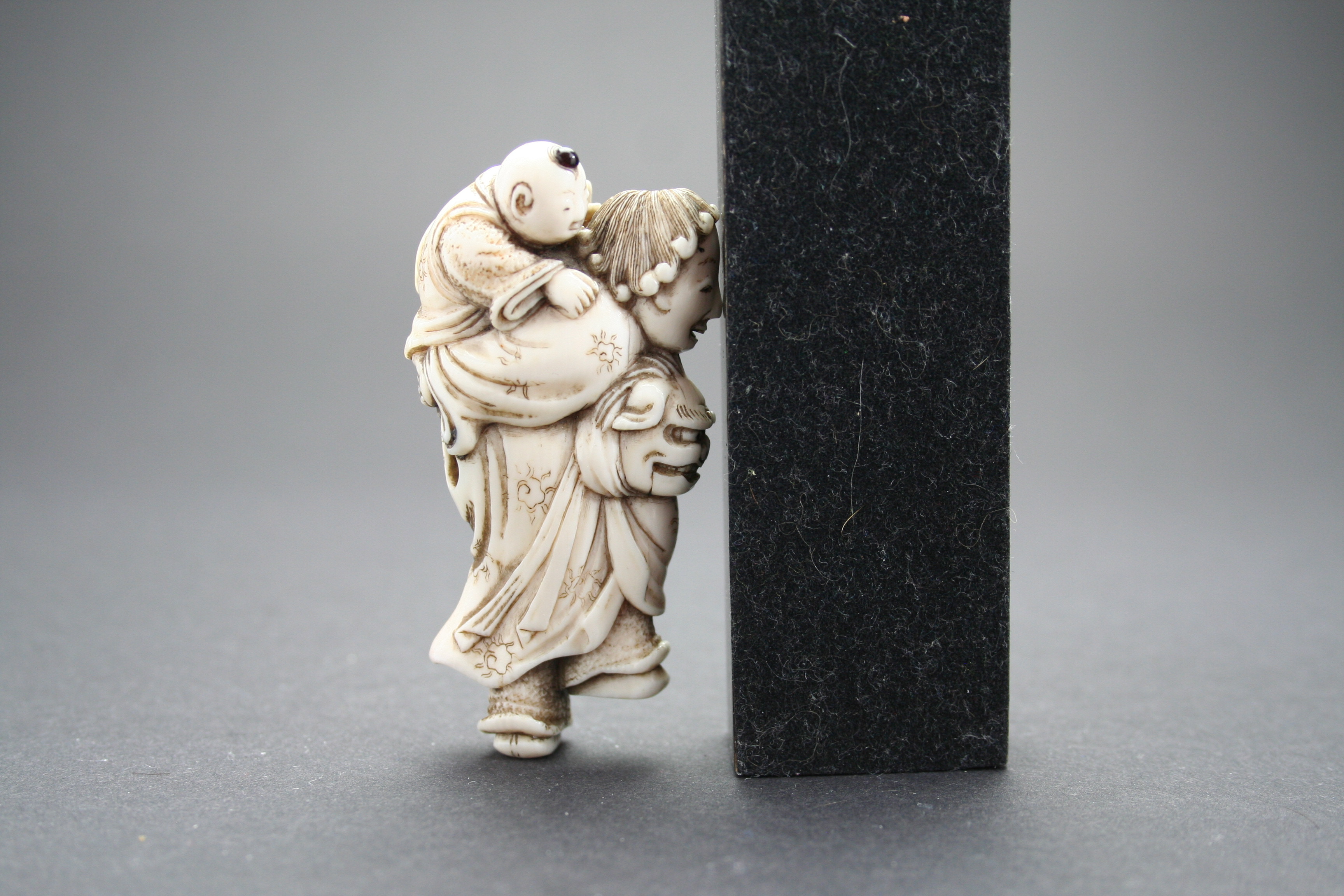
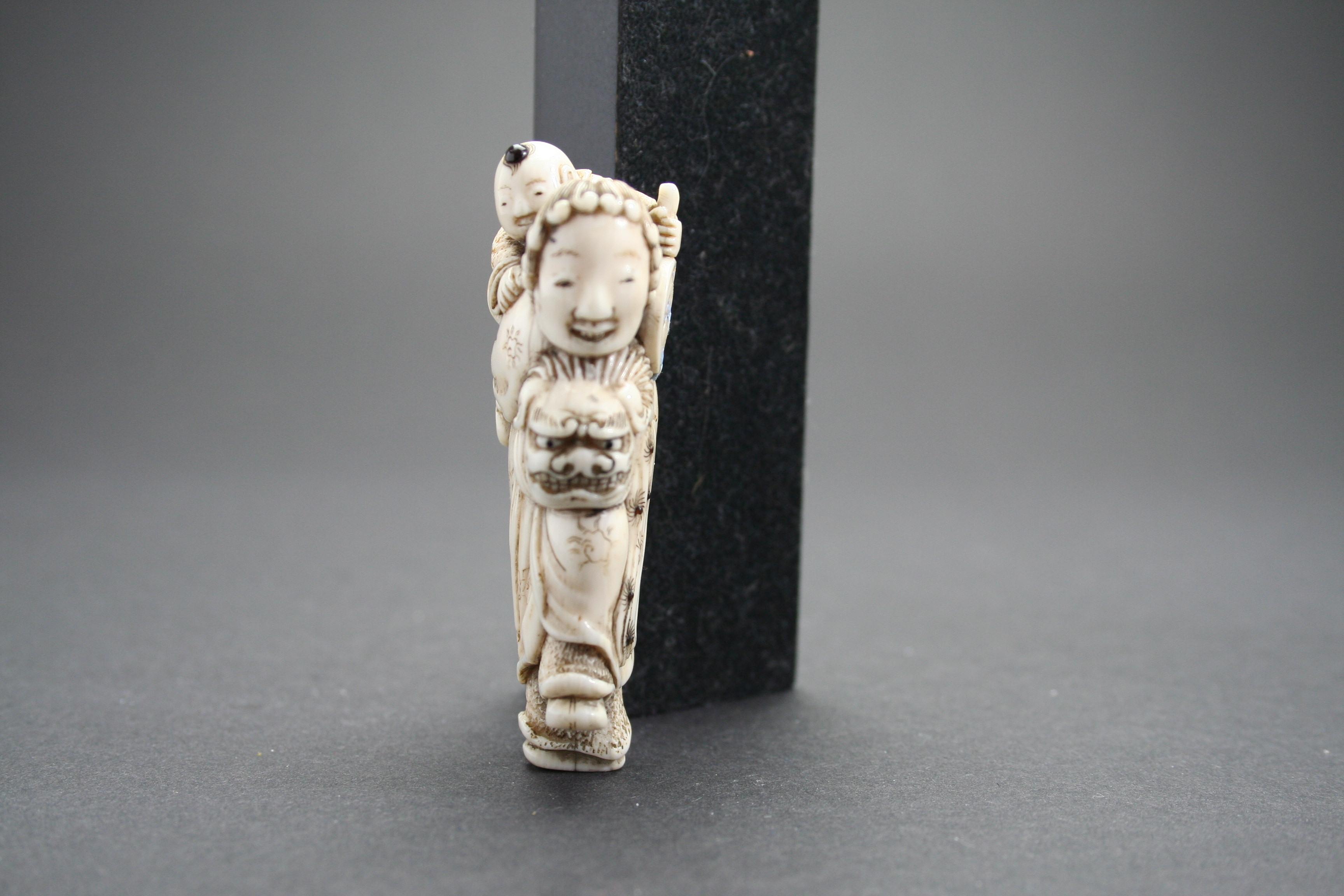
- Dutchman with child on back and lion dance-mask


Dutchman with child on back and lion dance-mask
Information
| Title | Dutchman with child on back and lion dance-mask |
| Date | c. 1775-1825 |
| Signature | Masakazu 正一 |
| Height | 6,9 cm |
| Object number | SH2025-LP-266 |
| iterature references | Jirka-Schmitz, Patrizia. 2005. The World of Netsuke: The Werdelmann Collection at the museum kunst palast Düsseldorf. Stuttgart: ARNOLDSCHE Art Publishers. |
| Credit Line | Collection Japan Museum SieboldHuis, donated by Mrs. E.Y. de Koster and Mrs. G. Zellentin, 2025 |
Description
This Dutchman is supporting a child on his back with his right hand, while holding a mask and cloth for the lion dance in his left. The lion dance isn’t typically associated with Dutchmen, but the curl wig and exaggerated facial features are unmistakable characteristics of Dutchmen in netsuke.
Children like the one carried here are often depicted in netsuke and are known as karako, or 'children from the Chinese Tang dynasty'. They symbolise the innocence and joy of youth. They are usually recognisable by the two tufts of hair on either side of their head, although this one has only been given a single tuft, right at the top of his head. He is also holding a drum.
As in this instance, the tufts of hair are often inlaid with soft coral. The eyes of the lion dance mask and the buttons on the cloth are also inlaid with this material.
For further information on the representation of foreigners in carvings, see our collection story: Hollanders in Japanse snijkunst.
Masakazu (正一) was a popular pseudonym amongst netsuke carvers as the characters were easy to carve neatly. This is probably a work by the same Masakazu as is described in Jirka-Schmitz (2005, p. 311), an early 19th-century workshop in Kyoto. The signature is identical to cat. 102, and the lion dance mask is carved in the same style as cat. 302.